What assumptions about “normal” schooling are embedded in the NCES dataset classification system – and how do labels like “Regular,” “Remote,” and “Virtual” shape which educational pathways are valued or marginalized?
Introduction
Educational data systems do not just record information about schools; behind the scenes, they are actively shaping how we believe schooling should be. This dynamic immediately connects to the bureaucratic imagination: the way institutions segregate and label complex information to make data more manageable. Through these labels, bureaucracies create the vision for a “normal” school, while in the process making other schooling forms seem not ‘normal’ or less legitimate.

The National Center for Education Statistics (NCES) makes the process of bureaucratic imagination apparent. Several categories highlight this and will be examined, such as the “School Type” and “Ulocale” columns. Within the “School Type” category, the labels used are: “Regular School”, “Alternative Education School”, “Career and Technical School”, and “Special Education School”. These labels discreetly encode normative assumptions within seemingly neutral terminology. The NCES implicitly establishes the ideal school as traditional and academically oriented serving the mainstream student populations. Schools that are not marked as ‘Regular’ are linguistically implied as outside the norm, whether it be because it serves students with disabilities or nontraditional instruction.
The “Regular” School as Default

From the highlight table, it is seen that “Not Virtual” has the largest proportion due to the impact of regular school. This reveals that the NCES expects the in-person format for “regular” (traditional) schooling, highlighting the historical preference for students to attend classes in person. Even after COVID-19, we can still see that the majority of virtual status is not virtual. In contrast, the virtual with face-to-face options have 174 regular schools, which indicates that the hybrid option is designed to enhance in-person learning rather than replacing it entirely.
Alternative Education, Career and Technical, and Special Education schools have fewer fully virtual options, suggesting that these types of schools prioritize hands-on and experimentation learning, as activities such as health examinations or childcare training are difficult to replicate online. This pattern highlights how certain educational pathways are structured around in-person learning, reinforcing NCES’s belief that the “normal” or default school experience is primarily face-to-face.
This connects to the Freedom Schools established during the U.S. Civil Rights Movement. The curriculum prioritized things like empowerment against White supremacy, social justice, and Black history, as opposed to the “regular” academically oriented curriculum of traditional public schools. Freedom Schools reveal how much the “Regular School” label excludes. The practices that Freedom Schools used are absolutely invisible under the NCES’s taxonomy, demonstrating that bureaucratic labels not only try to define what is “normal” but also erases what is outside of this norm.
Geographic Labels and Their Implications
The NCES ULocale category classification is another example of bureaucratic imagination shaping our beliefs of school. By reducing complex geography into 4 categories, “City”, “Suburb”, “Town”, and “Rural”, each with subtypes such as “Remote”, “Distant”, and “Fringe”, a geographic hierarchy is created. Our data visualizations show a seemingly neutral distribution of schools across labels, yet the terminology itself is nowhere near neutral. Labels like “Remote”, “Distant”, and “Fringe” carry strong connotations, framing communities as physically and socially removed from ‘the center’. ‘The center’, or what could be described as what is ‘normal’ is implied to be cities and suburbs. A distance label, such as “Remote” does not indicate mileage from nearby suburbs or cities, it indicates the lack of proximity to resources that matter most to bureaucracies. In a similar way, the “Fringe” label creates a disconnect between suburban schools partially connected to the mainstream and what the bureaucracies see as desirable or well-resourced suburban schools.
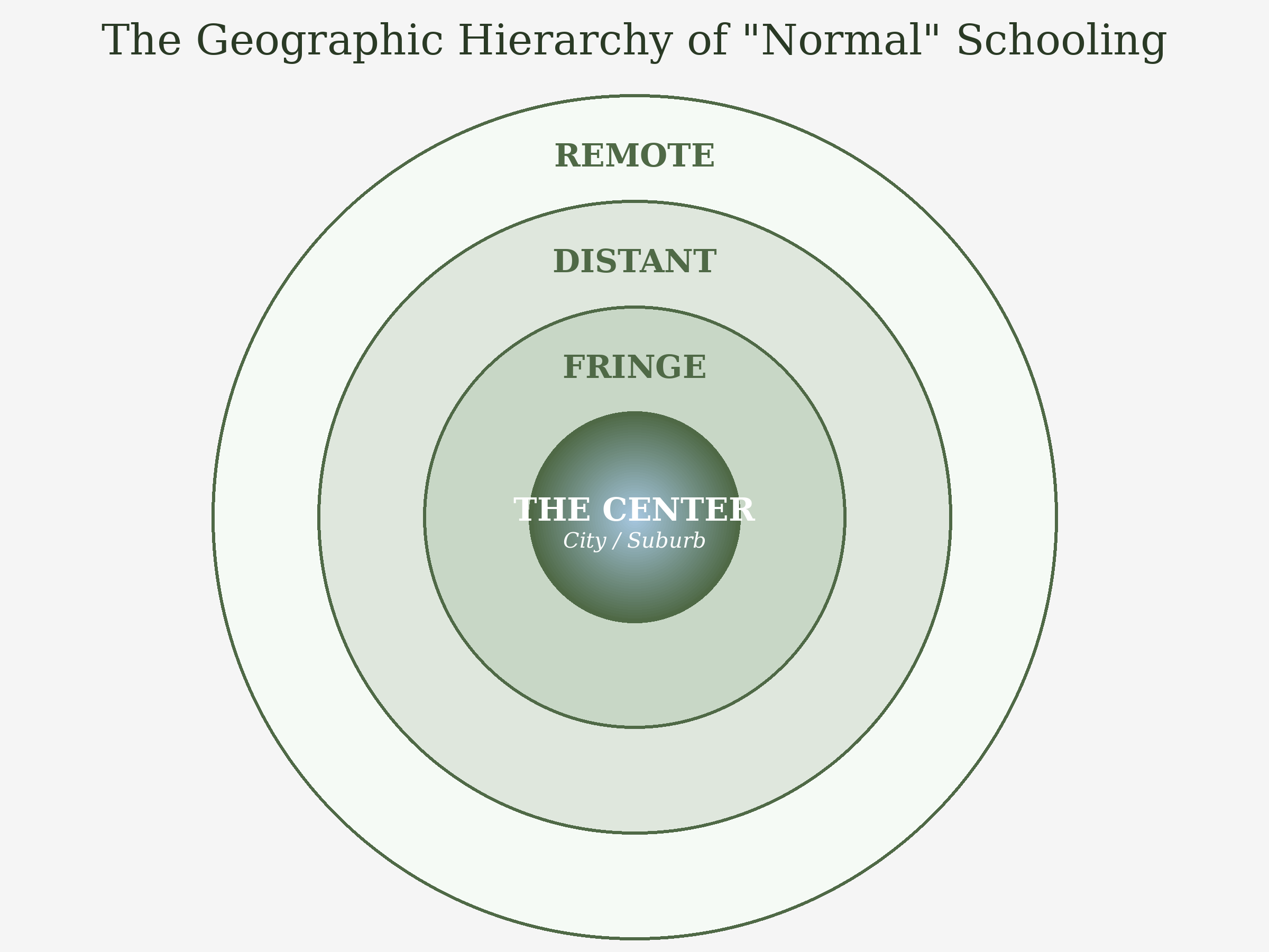
Labels like “Remote”, “Distant”, and “Fringe” carry strong connotations, framing communities as physically and socially removed from ‘the center’. ‘The center’, or what could be described as what is ‘normal’ is implied to be cities and suburbs. A distance label, such as “Remote” does not indicate mileage from nearby suburbs or cities, it indicates the lack of proximity to resources that matter most to bureaucracies. In a similar way, the “Fringe” label creates a disconnect between suburban schools partially connected to the mainstream and what the bureaucracies see as desirable or well-resourced suburban schools
These classifications “demonize” specific geographic features by treating distance as an educational deficit, instead of simply being a descriptive fact. This results in a system where the mapping of schools encodes negative assumptions of disadvantageous locations and reveals which are closest to the bureaucratic ideal of a “normal” school area.
What’s Missing From the Data
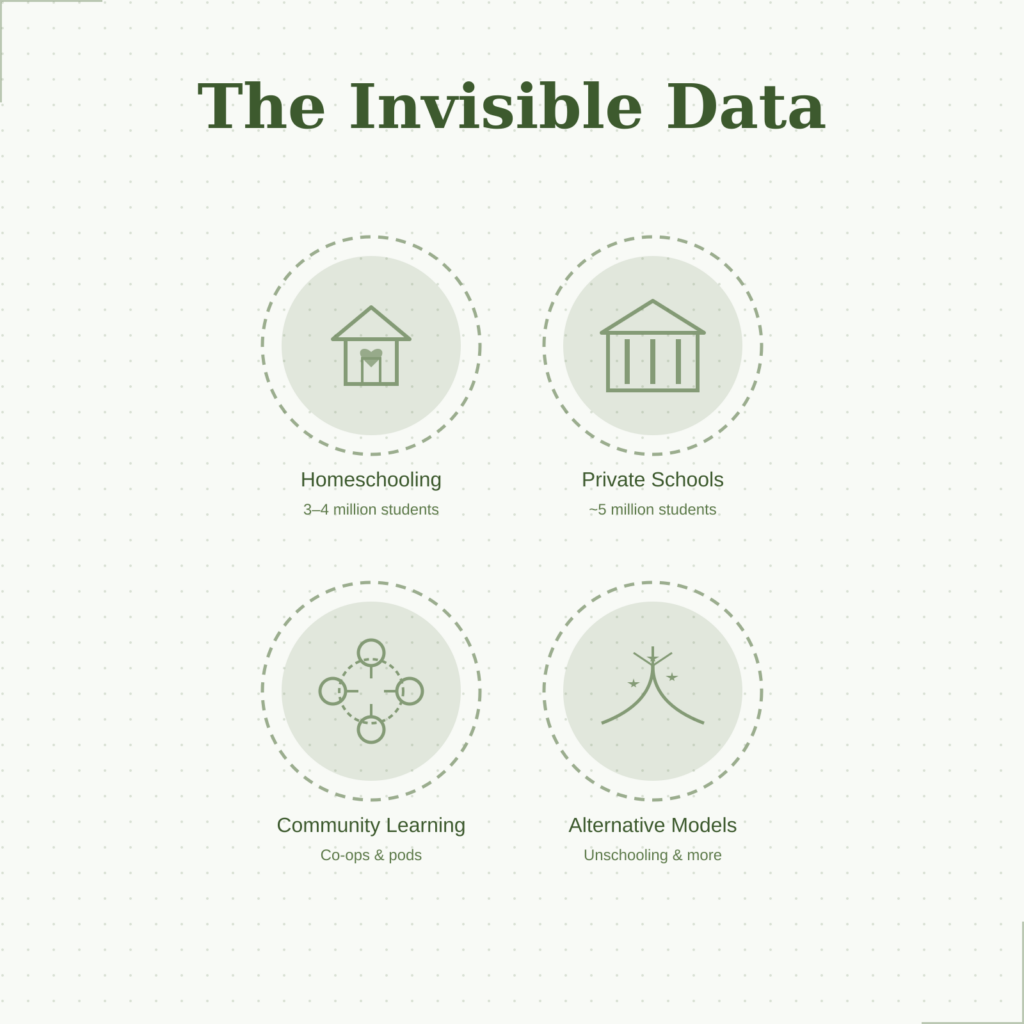
Aspects of the NCES dataset that are missing also tell a story. As Taylor & Cantwell (2019) note, data is not entirely consistent through the dataset as families with more financial resources often pursue educational options outside the public system, such as private schools or homeschooling. This effectively creates a massive gap in the data; the dataset only covers the population that remains within the bureaucratically defined public schooling. This dataset prioritizes schools with grade levels, teacher counts, and testable population. When an education does not fit these exact qualifications, it turns invisible in the eyes of the NCES.
Real World Impact
These labels also make a real-world impact, guiding how educational resources are distributed. Categories like “Regular School” become bureaucratic defaults, and are seen as deserving of investment. On the other hand, schools labeled “Alternative Education School”, “Career and Technical School”, or “Special Education School” are seen as deviations from the ideal, making it easier for policymakers to justify uneven funding. In a similar way, geographic labels carry consequences. Schools labeled with “Remote” or “Fringe” reinforce narratives of isolation and deficiency often leading policymakers to assume that lower performance and limited access are inevitable, reducing urgency for investment. As Curran and Kitchin (2021) explain, geographic classifications directly shape access to funding, staffing, transportation, and other resources. This results in districts receiving bare minimum resources needed to function, rather than the additional support necessary to overcome these geographic barriers.
This calls for more inclusive ways of understanding educational pathways. A more inclusive approach would be to recognize the diverse array of learning models like public, private, virtual, and alternative not as deviations from the norm, but as legitimate educational pathways. In doing this, policies that respond to student needs, rather than bureaucratic assumptions, would be enforced. Once educational pathways are understood in this broader way, resource allocation will shift accordingly. Funding will not be based on narrow bureaucratic labels, but rather the actual needs of students. This reframing ultimately promotes equity; all educational models should be seen as worthy of investment.